Development and Growth of Administrative Theories
What a theory does, how the field’s questions changed, and the identity and values of the discipline.
Paper I Unit 1 Introduction, Unit 2 Administrative Thought and Unit 7 Comparative Public Administration. Paper II Unit 8 Civil Services and Unit 10 Administrative Reforms since Independence.
What a Theory Does
A theory relates concepts so that an observed pattern can be explained and, under specified conditions, anticipated. A description records that a file passed through several levels. A theory proposes why hierarchy creates that pattern and what effect it has. A mechanism might be that officials refer cases upward because only senior officers have authority to approve exceptions. The explanation can be tested by observing cases after a lawful delegation of authority.
Normative propositions ask what administration should value. Empirical propositions ask what happens and why. Design propositions connect desired outcomes to arrangements expected to produce them. A claim that citizens deserve equal treatment is normative. A claim that a document requirement increases exclusion is empirical. A proposal for assisted verification combines evidence with a commitment to access. Good answers make these elements explicit.
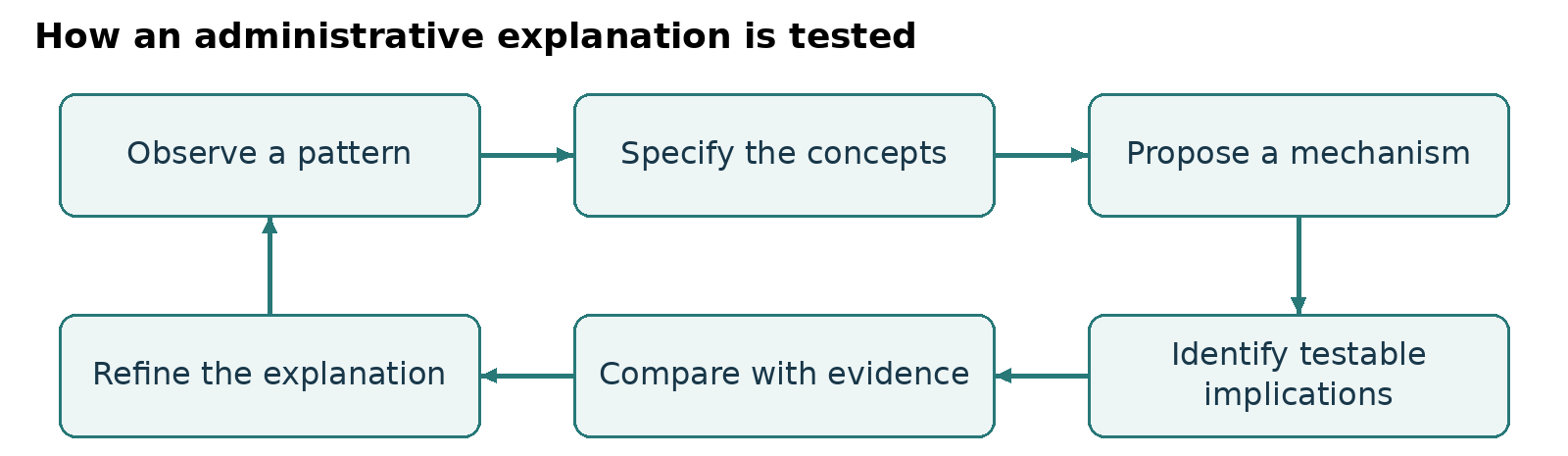
Figure 4 How an administrative explanation is tested
How the Field’s Questions Changed
| Tradition | Main unit of analysis | Characteristic question |
|---|---|---|
| Wilson and early administration | Government machinery and execution | How can administration be studied systematically |
| Scientific Management | Task and work method | Which method improves repeatable performance |
| Administrative Management | Executive and formal structure | How should work be grouped, directed and coordinated |
| Weberian sociology | Authority, office and legitimacy | Why do people obey an impersonal office |
| Human Relations | Work group and social relationships | How do group norms and supervision affect behaviour |
| Behavioural decision theory | Choice and decision premises | How do people decide under limited information and attention |
| Systems and contingency | Organisation and environment | Which structure fits the task and conditions |
| New Public Administration | Public values and distribution | Who gains and who bears administrative costs |
| Public Choice and New Public Management | Incentives and performance | How do incentives, autonomy and measurement shape delivery |
| Governance perspectives | Interdependent actors and accountability | Who coordinates and who answers for shared delivery |
These traditions coexist because they explain different problems. A district hospital needs Taylor’s attention to repetitive work, Weber’s record and authority controls, group cooperation and discretion for uncertain clinical decisions. Historical progression helps organise the field, but the suitability of a theory depends on what needs explanation.
The classical search for principles assumed that recurring problems in organisation allowed general prescriptions. Simon challenged those prescriptions by showing that a contrary principle could often be invoked. Narrow supervision can strengthen control, while fewer layers can reduce delay. Evidence and conditions determine which consideration dominates.
Comparative Public Administration emphasised the relation between administration and its environment. Riggs drew attention to the gap between formal structures and actual practices and to the need to situate administration in its social setting. A reform that assumes reliable records, skilled staff and credible enforcement may work differently where those complements are weak. Comparative explanation should specify which environmental factor changes the mechanism.
Building a Defensible Argument
Begin with a question and select the relevant level of analysis. A rising backlog may reflect a poorly designed task, an informal norm, decision overload or an interagency bottleneck. The remedy differs depending on the mechanism. Gather evidence on where time is spent, who can decide and what happens to exceptions. Test plausible alternatives before attributing the problem to staff motivation or hierarchy.
Middle-range explanations connect a mechanism to a bounded set of circumstances. They are valuable where large claims about all bureaucracies exceed the evidence. For example, tighter targets may speed routine cases when quality is observable. The same targets may encourage staff to close complex cases without resolution when output counts dominate appraisal.
The Identity and Values of the Discipline
Nicholas Henry’s paradigm account uses locus and focus to examine the discipline’s identity. Locus asks where administration is located, such as government institutions. Focus asks what specialised knowledge or technique defines the field. Periods of emphasis on public institutions and periods of emphasis on general management reveal different answers to what makes Public Administration distinctive.
Dwight Waldo argued that administrative arrangements reflect political values. The pursuit of efficiency assumes a view of what counts as a valuable result. New Public Administration gave particular attention to relevance and social equity. Public Choice later sharpened the analysis of incentives and collective decisions, while New Public Management advanced instruments such as output targets and managerial autonomy. Each perspective offers a way to test an institutional claim. For example, a performance agreement can improve accountability when quality is observable and can shift effort away from unmeasured citizens when access is difficult to observe.
Does the evolution of administrative theory show a movement from principles to context?
Answer direction. Trace the classical concern with structure and the behavioural turn towards decision and observation. Use contingency and comparative administration to explain context. Show how classical insights still operate where their assumptions hold.
Previous: Nature and Typologies of Organisation | Next: Taylor and Scientific Management
📣 Join our community