Contemporary Indian Bureaucracy
Recruitment, role, political relations and reform in the Indian civil service.
Paper I Unit 2 Administrative Thought, Unit 3 Administrative Behaviour and Unit 9 Personnel Administration. Paper II Unit 8 Civil Services and Unit 10 Administrative Reforms since Independence provide the Indian setting.
Why Bureaucracy Persists
Max Weber analysed bureaucracy as an ideal type associated with legal-rational authority. An office has a defined jurisdiction. Recruitment rests on qualifications. Hierarchy allocates authority. Written records preserve continuity and enable review. Officials act through the office rather than through a personal claim to rule. An ideal type isolates characteristics for analysis and helps compare organisations that display them in different degrees.
These arrangements protect citizens when they make eligibility and official decisions predictable. They also support complex coordination. A treasury, election administration or public health system needs repeatable procedures, clear authority and auditable records. The question for reform is which procedures protect public purposes and which impose costs that serve little purpose.
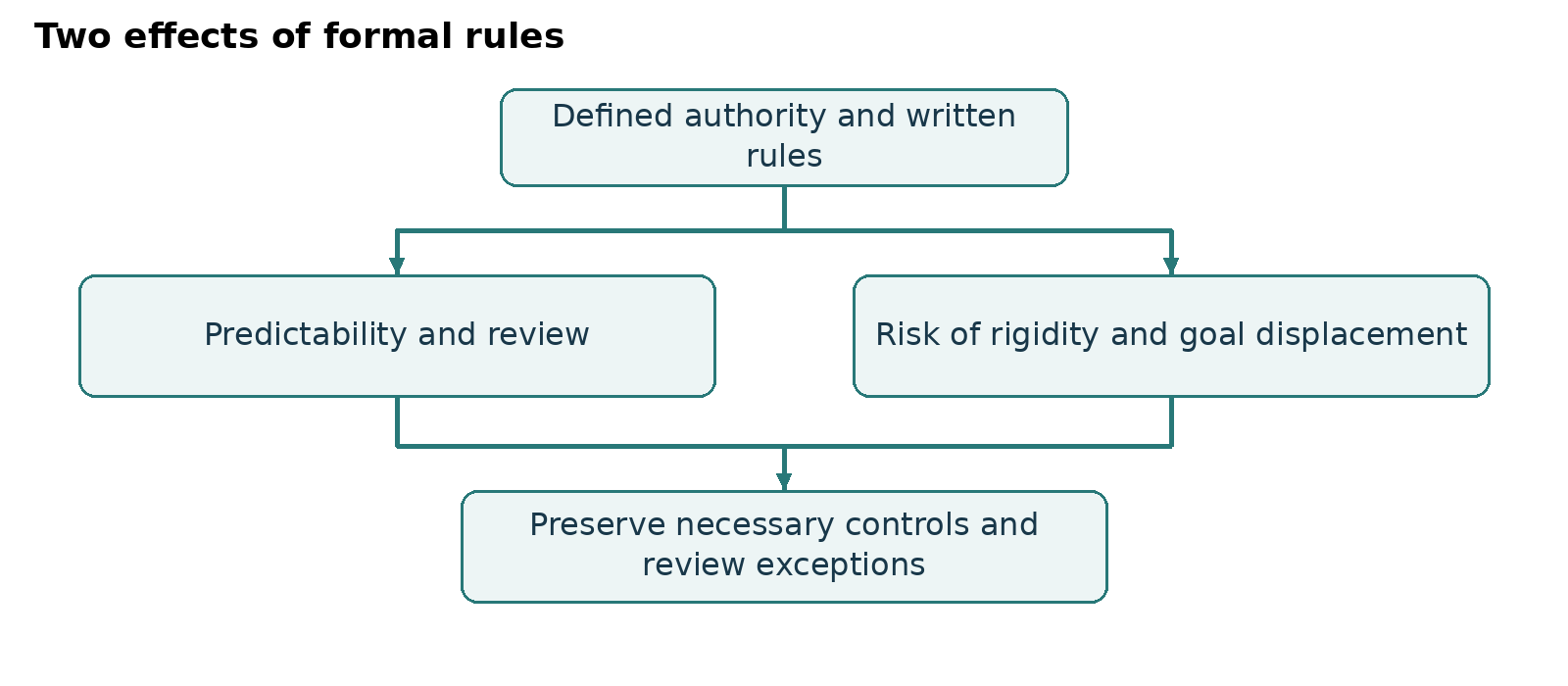
Figure 4 Two effects of formal rules
Dysfunction and Adaptation
| Perspective | Mechanism | Administrative illustration |
|---|---|---|
| Merton | Rules become ends through goal displacement | Staff optimise file completeness while eligible cases wait |
| Selznick | Organisations adapt to external interests and may alter their original purposes | A partnership secures support but gives dominant participants disproportionate influence |
| Crozier | Rules and centralisation can reinforce uncertainty and rigidity | Staff who control exceptions acquire informal power |
| Human relations | Informal groups and peer norms influence work | Staff share practical knowledge or jointly discourage initiative |
| Street-level bureaucracy | Frontline routines translate scarce resources into practical eligibility | A worker prioritises cases easiest to process |
Formalisation is useful where similar cases need similar treatment and errors have serious consequences. A rigid procedure becomes dysfunctional when its assumptions no longer fit the task. Unrecorded flexibility can create unequal treatment. The institutional response is a clear standard with a lawful exception route, written reasons and review.
The Indian Civil Service Setting
The Indian bureaucracy combines All India Services, Central services, State services and specialised personnel. Its responsibilities range from policy advice and financial stewardship to field coordination and citizen-facing delivery. All India Services illustrate the need for coordination across levels of government. District responsibilities illustrate the combination of development, emergency management and field administration.
Articles 309, 310 and 311 frame major aspects of service regulation, tenure and safeguards. Articles 315–323 concern Public Service Commissions. Article 312 provides a route for creating All India Services. These provisions operate alongside laws and service rules. Their administrative purpose is to balance continuity, impartial recruitment, responsibility and due process. Security of tenure can protect honest advice. Performance management and disciplinary processes remain necessary to address misuse.
The political executive has a democratic mandate. The permanent executive has a duty of impartial service, sound advice and lawful implementation. Frequent transfers can erode continuity and discourage frank advice. Insulation without accountability can shield weak performance. A credible arrangement identifies the reasons for a posting or transfer, the competent authority and the means to review arbitrary decisions.
Generalists Specialists and Representation
Generalists bring coordination experience, familiarity with government processes and the ability to integrate different sectoral concerns. Specialists bring domain knowledge that matters for areas such as cybersecurity, finance and public health. The coordination problem arises when expertise reaches a decision only after the main options are settled, or when specialists cannot connect their advice to fiscal, legal and political constraints. Multidisciplinary teams and clear authority can address both problems.
Representative bureaucracy distinguishes passive representation, which concerns who serves, from active representation, which concerns what officials do within their mandate. Diversity can improve problem recognition and legitimacy. Actual responsiveness depends on discretion, organisational incentives, professional norms and accountability. Identity alone gives an incomplete account of administrative behaviour.
Designing Reforms Around Problems
| Problem | Reform mechanism | Evidence of improvement |
|---|---|---|
| Disruptive turnover | Transparent placement, reasoned transfers and continuity in sensitive roles | Handover quality and delivery across changes of personnel |
| Weak domain competence | Role-based learning and specialist participation | Ability to resolve substantive cases |
| Rigid procedures | Delegation, simplified rules and reviewable exceptions | Reduced rework with comparable decisions |
| Weak appraisal | Defined objectives, periodic feedback and contextual review | Improvements beyond self-reported target attainment |
| Poor public trust | Reasons, disclosure, service standards and effective redress | Resolution verified by users |
The Second Administrative Reforms Commission considered civil service capacity, ethics and citizen centricity across its work. Mission Karmayogi offers an Indian example of linking learning to roles and competencies. In an answer, distinguish the design of a reform from evidence of results. Course completion measures participation in training. Better judgement in a work setting requires evidence of changed practice.
Ethics Professionalism and Organisational Support
Ethical conduct depends partly on individual judgement and partly on the conditions under which officials work. Vague instructions, opaque transfers and unrealistic targets can make integrity costly. Clear reporting routes, written decisions, supervisory review and protection for good-faith professional advice can make ethical conduct easier to sustain.
Recruitment, training and career management operate together. Recruitment sets the entry standard. Training builds capabilities for specific roles. Posting determines whether those capabilities are used. Appraisal and promotion signal which behaviours the organisation values. A reform that trains staff in evidence-based practice while rewarding only short-term output may have limited effect.
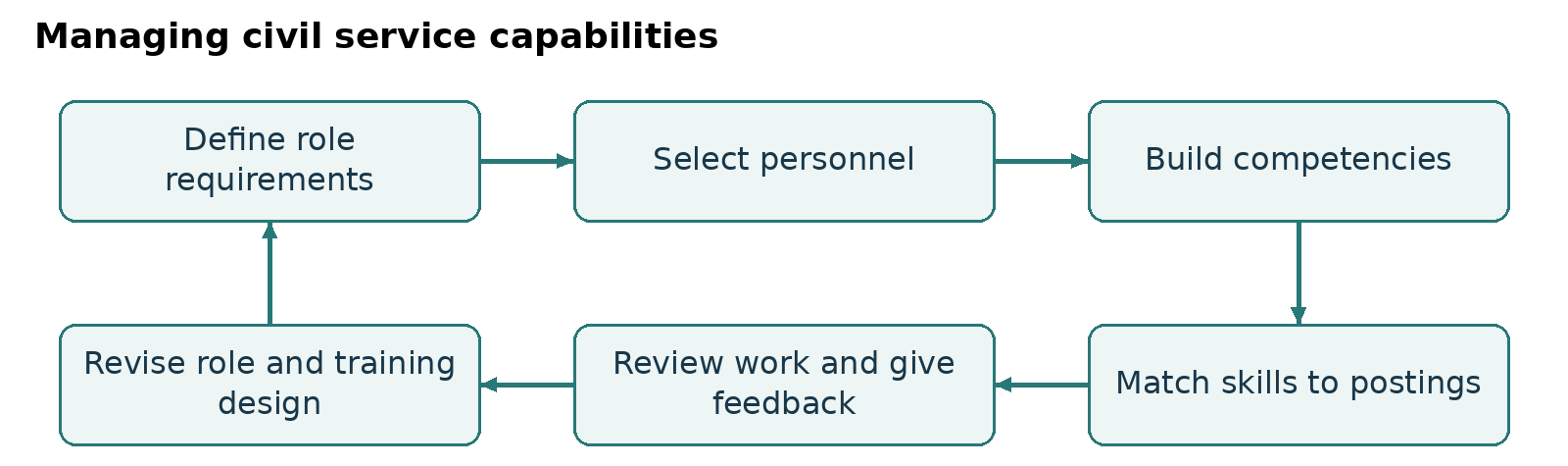
Figure 5 Managing civil service capabilities
Which Weberian features should Indian civil service reform preserve, and where is adaptation necessary?
Answer direction. Identify merit, defined authority and written reasons as public safeguards. Use Merton or Crozier to explain a concrete dysfunction. Assess stable tenure, specialist input and structured discretion against accountability, capacity and access.
How can civil service neutrality be reconciled with responsiveness to elected leadership?
Answer direction. Separate lawful political direction from partisan use of public office. Discuss advice, implementation, equal treatment and written accountability. Explain the institutional role of tenure and review.
Previous: Changing Nature of the Indian State | Next: Reforming Governmental Institutions
📣 Join our community