Challenges to Traditional Bureaucracy
Why classical bureaucracy is challenged and what replaces or supplements it.
Paper I Unit 1 Introduction, Unit 2 Administrative Thought and Unit 3 Administrative Behaviour. Paper II Unit 8 Civil Services and Unit 10 Administrative Reforms since Independence.
The Traditional Paradigm and Its Limits
Traditional bureaucratic administration organises public work through hierarchy, specialised offices, written rules and formal responsibility. These arrangements support consistency, continuity and review. They work especially well for stable tasks where rights and duties must be determined by common standards. Their weaknesses become visible when problems cross departmental boundaries, outcomes require local adaptation or rules are treated as proof of success.
A centralised hierarchy can coordinate action, but information may lose detail as it travels upwards. Specialisation makes expertise possible, but it can split a citizen’s problem into pieces that nobody owns. Impersonal treatment curbs favouritism, but identical procedures may impose unequal burdens. These are tensions within bureaucratic design. Each alternative paradigm gives a different answer to which public value should guide reform.
New Public Administration
New Public Administration is associated with the late 1960s Minnowbrook discussions and H. George Frederickson’s emphasis on social equity. It questioned the adequacy of efficiency and economy as the sole criteria of administrative success. Public organisations distribute resources and burdens through ordinary decisions about location, eligibility, staffing and enforcement. Those decisions have consequences for equity.
Consider opening a welfare desk in the highest-volume location. The choice may reduce cost per transaction while lengthening travel for the most isolated applicants. An equity-oriented review compares access and outcomes across groups and locations. It can justify outreach or assisted access where the barriers are greatest. Such adaptation still requires a legal basis, explicit criteria and review.
New Public Management
New Public Management groups reforms that emphasise managerial discretion, performance measurement, disaggregation and selective use of market mechanisms. Its diagnosis is that detailed input controls and producer monopolies can weaken attention to service results. Its instruments include measurable service standards, contracts, purchaser-provider separation and autonomy for managers.
These tools can sharpen responsibility where outputs are definable and independently verifiable. They can distort priorities where performance is difficult to capture. A target for cases closed may encourage premature closure. Competitive providers may avoid costly users unless payment and service obligations account for differences in need. Public law and access requirements therefore remain relevant to managerial design.
Organisational Humanism
Organisational humanism examines whether work systems allow people to develop competence, initiative and responsibility. Chris Argyris identified tensions between mature adult development and rigid organisational arrangements that keep people dependent and narrowly specialised. Douglas McGregor’s Theory X and Theory Y contrast managerial assumptions about motivation. Theory Y allows that people can exercise self-direction under suitable conditions.
Participative work design brings knowledge from those closest to operational problems into decisions. A hospital can use frontline staff to identify why discharge papers are delayed. If they have no authority, time or access to relevant data, participation will have limited effect. Delegation works better when staff know the purpose, constraints and standards of the decision and receive feedback on its results.
New Public Service and Network Governance
Janet and Robert Denhardt’s New Public Service draws on democratic citizenship, community and dialogue. Citizens have a role in determining public purposes. A citizen can be a taxpayer, a rights-holder, an affected resident and a participant in collective decisions at the same time. Service quality includes how government treats those roles and explains trade-offs.
Network governance examines coordination among interdependent actors with distinct powers and resources. An urban flood programme can involve municipalities, drainage agencies, residents and utilities. Collaboration requires common information, assigned responsibilities and escalation when actors disagree. A network may improve coordination while obscuring accountability if no institution remains answerable for the outcome.
| Approach | Central concern | Typical tool | Main vulnerability |
|---|---|---|---|
| Traditional bureaucracy | Legality and continuity | Rules and hierarchy | Rigidity and compartmentalisation |
| New Public Administration | Equity and relevance | Distributional review and outreach | Equity goals may lack resources or measures |
| New Public Management | Results and economy | Targets and contracts | Gaming and fragmentation |
| Organisational humanism | Initiative and development | Delegation and participative management | Participation without authority |
| New Public Service | Democratic citizenship | Deliberation and public reasoning | Unequal voice and resource-intensive engagement |
| Network governance | Interdependent delivery | Joint protocols and coordination | Diffuse responsibility |
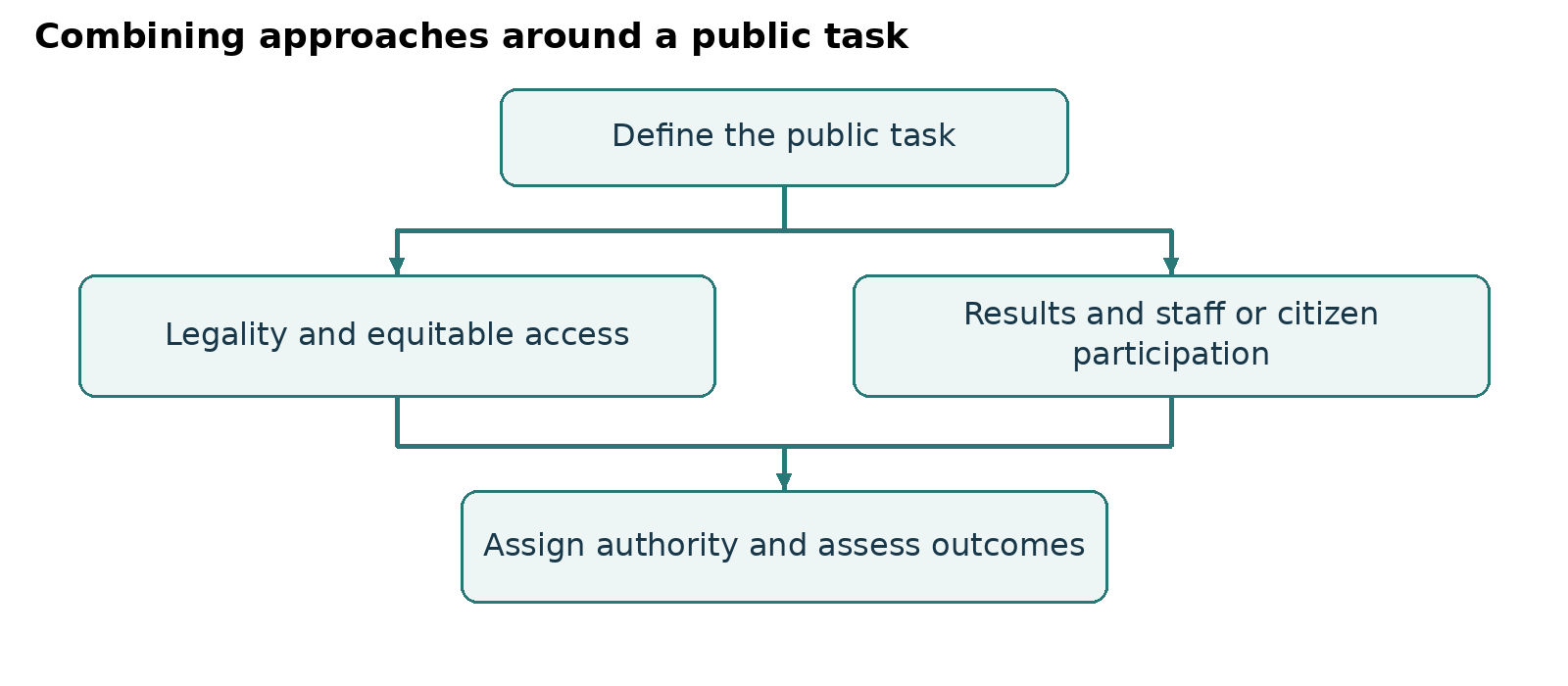
Figure 7 Combining approaches around a public task
Choosing the Administrative Arrangement
Match the design to the task. A benefit entitlement needs predictable eligibility and appeal. A complex design problem benefits from professional judgement and staff participation. A service with measurable quality may use performance standards. A decision over contested public space requires deliberation and reasons. Combining these tools requires explicit boundaries. A contractor can be held to a target while a public authority remains responsible for equitable access and grievance review.
Applying Competing Paradigms to One Service
Suppose a district office processes disability-related applications. Weberian design asks for uniform eligibility, documented authority and a review trail. New Public Administration asks whether remote and low-income applicants face unequal access costs. New Public Management examines delay, cost and completion. Organisational humanism asks whether frontline staff can propose and test improvements. New Public Service examines whether persons with disabilities participate in redesign and can challenge decisions.
The five lenses can produce different recommendations from the same evidence. A managerial target may accelerate standard cases while equity requires more time for complex ones. A design can reconcile these purposes by disaggregating performance, allowing lawful assistance and measuring completion for applicants facing different barriers.
Compare the diagnoses of traditional bureaucracy offered by New Public Administration, New Public Management and New Public Service.
Answer direction. Define the common starting point. Compare their views of the problem, the citizen’s role and the instrument of reform. Apply each lens to one service and assess what it reveals about access, performance and democratic authority.
What does organisational humanism add to a rules-based reform of bureaucracy?
Answer direction. Explain Argyris and McGregor. Connect discretion and staff development to service quality. Identify when law, supervision and escalation are necessary.
Previous: Globalisation and Public Administration | Next: New Public Management, Reinventing Government and Process Redesign
📣 Join our community