UPSC Mains Questions and Worked Answers
2025 Paper I question outlines, a model answer, a backlog diagnosis and how to write to the directive.
Previous Year Questions by Theme
These are paraphrased question demands from the 2025 UPSC Civil Services Main Examination, Public Administration Paper I. The question numbers allow you to locate the original wording in the official paper. The answer directions are study aids.
| 2025 Paper I question | Question demand in brief | Answer plan |
|---|---|---|
| 1(a) · 10 marks | Explain how imperfect markets and politics limit Public Choice | Define the approach. Explain entry barriers, information gaps and concentrated political influence. Use one municipal service example and state the institutional conditions for improvement |
| 1(d) · 10 marks | Assess Simon’s criticism of administrative principles as proverbs | Contrast competing prescriptions on span or departmentalisation. Explain why empirical conditions matter. Retain classical principles as conditional design hypotheses |
| 2(a) · 20 marks | Examine whether New Public Management was a transitional stage towards New Public Governance | Compare hierarchy, managerial performance and network coordination. Show which NPM tools persist. Examine accountability across shared delivery and state where the transition claim is useful |
| 2(b) · 15 marks | Explain Follett’s contribution to a socio-psychological understanding of organisations | Explain circular response, constructive conflict and the law of the situation. Show how authority emerges through interaction and knowledge. Illustrate coordination and discuss power asymmetry |
| 2(c) · 15 marks | Analyse how PPPs under NPM address organisational entropy in closed and open models | Define entropy as declining capacity to adapt or sustain functioning. Show how partnership supplies resources and feedback. Examine contract failure, capture and unclear accountability |
Official UPSC 2025 Public Administration Paper I
Model Answer on Simon and Administrative Principles
2025 Paper I Question 1(d) · 10 marks. Simon argued that several classical principles were persuasive maxims whose opposites could also sound convincing. A narrow span of control can improve supervision. It may also increase hierarchical levels and slow communication. Grouping work by purpose integrates a programme, while grouping by process concentrates specialist expertise. A principle gives limited guidance when it does not specify the conditions that make one arrangement superior.
A district service illustrates the point. Routine applications can be handled under common procedures and broader supervision. Complex exceptions may need closer technical support. Organisational design should therefore be tested against case variety, staff competence, speed, error rates and access.
Simon’s criticism is strongest against claims of universal validity. Classical principles remain useful as hypotheses for designing authority and coordination. Their practical value depends on making the objective explicit and testing the prescription against the actual administrative setting.
One Backlog Five Administrative Explanations
A district pension office has rising delays, repeated returns and high closure counts. Treat the backlog as a symptom. Each thinker asks a different question and points to different evidence.
| Lens | Diagnosis to investigate | Evidence | Response if supported |
|---|---|---|---|
| Taylor | Repetitive work uses inefficient methods | Observe re-entry, rework and active processing time | Simplify routine checks and train staff in a tested method |
| Fayol and Gulick | Several units share the task without clear direction or ownership | Map conflicting orders and unresolved handoffs | Establish one service plan, defined authority and coordination |
| Weber and Merton | A safeguard has become an end in itself | Compare file compliance with lawful and timely delivery | Retain the purpose of the safeguard and create a reviewable exception route |
| Mayo and Human Relations | Informal norms discourage cooperation or escalation | Compare workloads and speak to staff about trust, peer help and supervision | Repair team routines and make upward feedback credible |
| Simon | Staff decide with incomplete premises and limited attention | Inspect search steps, decision rules and when exceptions are escalated | Improve decision support and widen access to relevant information |
The first step is to trace several applications from entry to actual payment. If most delay comes from missing data at one handoff, Taylor and Gulick offer a stronger starting point than a general claim about low morale. If technically eligible cases are repeatedly returned for an irrelevant formality, Merton explains why the procedure survives despite the service failure. For a cross-paper answer, link the diagnosis to field administration and financial management, then show how verified payment and error rates would test the change.
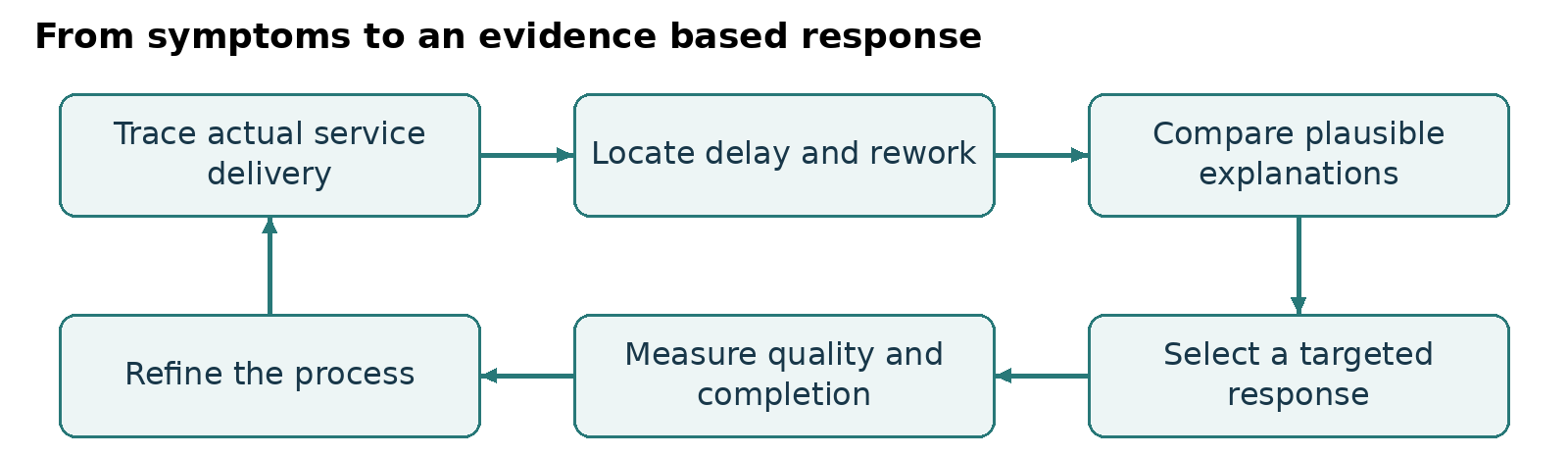
Figure 21 From symptoms to an evidence based response
Writing to the Directive
| Directive | What the answer must do | Example of an appropriate judgement |
|---|---|---|
| Explain | Establish the mechanism and show it operating | Informal sanctions can sustain an output norm even where formal incentives reward individual speed |
| Analyse | Break the claim into mechanisms and examine conditions and consequences | Narrower supervision helps when work is complex, while extra layers may slow simple approvals |
| Examine or critically examine | Test the argument against counterarguments and make a reasoned assessment | PPPs can improve adaptive capacity where public agencies can monitor and enforce performance |
| Compare | Use common dimensions and show where the differences matter | Weber, Barnard and Simon explain legal legitimacy, acceptance and decision influence respectively |
For a short answer, define the issue, develop two or three connected points and give one precise example. For a longer answer, state the competing explanation, identify the conditions under which each claim holds and give a qualified judgement. A diagram should show a relationship that the answer then explains. Use examples to establish a mechanism and reserve space for the question’s directive.
Previous: Likert, Argyris and McGregor on Participative Management | Next: Central Matrix: Administrative Thought and Organisations
📣 Join our community