Bureaucracy in the Policy Process
How bureaucracy shapes policy through advice, discretion and implementation.
Paper I Unit 10 Public Policy, Unit 2 Administrative Thought and Unit 3 Administrative Behaviour. Apply them through Paper II Unit 4 Union Government and Administration, Unit 7 District Administration since Independence and Unit 8 Civil Services.
Policy as a Continuing Process
Public policy is an authorised course of public action or inaction in response to a problem. A statute, budget, programme guideline and operational decision can each form part of a policy. The term policy cycle separates tasks for study. In practice, implementation can expose a defect in the original problem definition and push the issue back onto the agenda.
| Stage | Bureaucratic contribution | Question for accountability |
|---|---|---|
| Agenda setting | Combine complaints, administrative records and evidence to identify a problem | Which problems and populations are missing from the evidence |
| Formulation | Prepare options, costs, legal analysis and implementation plans | Were alternatives and trade-offs presented honestly |
| Authorisation | Support the competent political or statutory authority with a reasoned proposal | Who is entitled to decide |
| Implementation | Translate decisions into funds, staffing, rules and field routines | Can eligible people secure the promised service |
| Monitoring and evaluation | Track progress, test explanations and report unintended effects | Does evidence lead to correction |
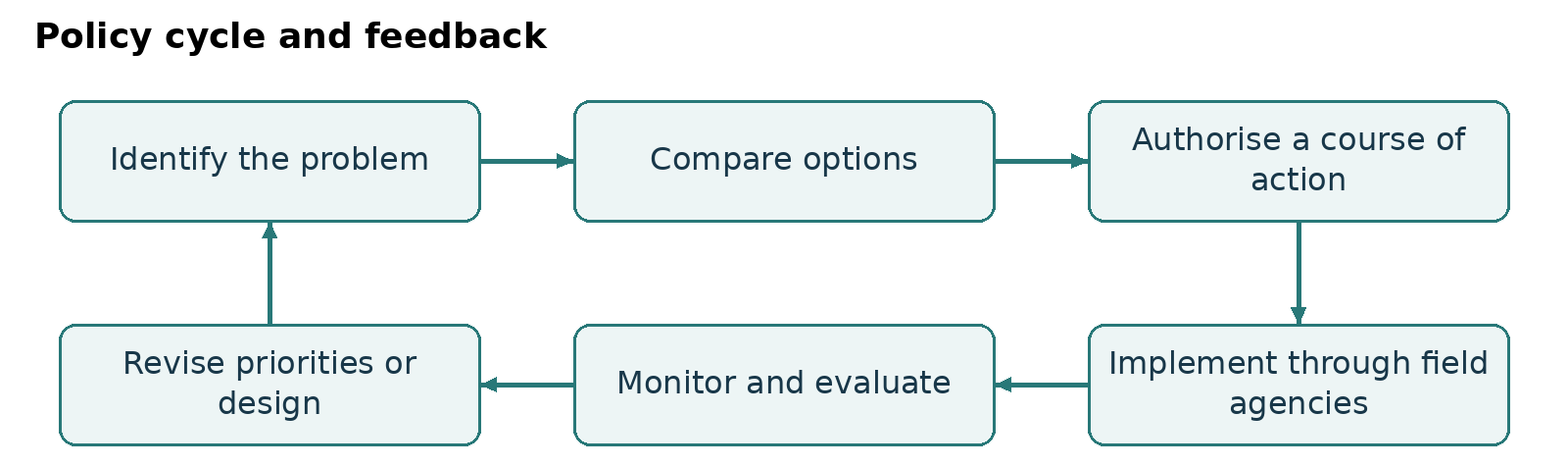
Figure 2 Policy cycle and feedback
Expertise and Political Responsibility
Ministers and legislatures provide political direction and authorise decisions within their respective powers. Officials contribute professional continuity, records, technical knowledge and experience with earlier programmes. The distinction between political direction and administrative execution remains valuable for responsibility. It becomes too rigid if it assumes that officials exert no influence over the choices available.
An officer influences policy through framing. If low enrolment is defined as lack of demand, a department may run a publicity campaign. If the same outcome reflects travel costs or an inaccessible registration process, the appropriate response changes. Evidence should include users who dropped out, applicants rejected at each step and places where services are unavailable. The way an option is written can shape the decision before it reaches the minister.
Professional advice should give feasible alternatives and explain risks, costs and distributive effects. After a lawful decision, officials implement it impartially and bring implementation failures back to the competent authority. Written records help identify who advised, who authorised and why. Neutrality permits frank advice and requires equal service across political affiliations.
Models of Policy Choice
| Model | Mechanism | Limit in practice |
|---|---|---|
| Rational comprehensive | Define objectives, compare alternatives and select the option with the best expected consequences | Evidence is incomplete and objectives may conflict |
| Simon’s bounded rationality | Search under limits of time, information and attention and accept a satisfactory option | What counts as satisfactory depends on thresholds and search design |
| Lindblom’s incrementalism | Adjust existing policies through limited comparisons and bargaining | Existing inequities may survive when only small adjustments are considered |
| Mixed scanning | Combine broad strategic review with detailed examination of selected decisions | Choosing where to concentrate scrutiny is itself consequential |
| Multiple streams | Problems, proposals and political conditions can converge in a policy window | An available solution can gain attention even if the evidence is weak |
These models answer different questions. Simon explains the cognitive limits of decision makers. Incrementalism explains how bargaining and limited comparisons shape decisions. A multiple-streams approach helps explain why a proposal previously ignored can suddenly become actionable. In a UPSC answer, use a model to explain a particular choice rather than listing names.
Implementation and Frontline Discretion
Top-down analysis starts with objectives, authority and control. It asks whether the rules are clear, whether agencies have resources and whether performance can be monitored. Bottom-up analysis starts with the implementing organisations and people who encounter the policy. It asks how practical constraints and frontline choices determine outcomes. Both perspectives are needed when a uniform rule meets varied local conditions.
Michael Lipsky described frontline public workers as street-level bureaucrats. Caseload pressure and scarce resources encourage routines for managing demand. A routine can make delivery predictable and still exclude people whose circumstances do not fit standard categories. Structured discretion allows lawful accommodation, records reasons and leaves a review trail. Capacity building alone cannot solve a problem caused by unrealistic workloads or poor allocation of authority.
An implementation plan should connect the legal mandate to funding, staff, service standards, process owners and remedies. Coordination becomes especially important when one department maintains the eligible list, a second validates identities and another authorises payment. A programme can fail at the interfaces even when each department meets its internal targets.
Monitoring Evaluation and Policy Analysis
Monitoring is the continuing observation of implementation. Evaluation asks how well an intervention achieved its objectives, why results occurred and how they compare with an alternative or baseline. A department can monitor how many applications it processes each week. Evaluating impact requires examining whether the programme improved the intended outcomes and whether other factors explain the change.
| Evidence level | Example from a school meal programme | What it establishes |
|---|---|---|
| Input | Funds, food and staff available | Delivery capacity |
| Output | Meals served to eligible students | Volume of service |
| Outcome | Change in attendance or nutrition | An observed change in the intended condition |
| Impact | Change plausibly attributable to the intervention | Causal contribution, subject to evaluation design |
Ex ante analysis estimates consequences before a decision. Concurrent analysis identifies implementation problems while a programme runs. Ex post analysis assesses performance after sufficient evidence accumulates. Cost-effectiveness compares the cost of alternative ways to achieve a given result. Distributional analysis asks who gains, who bears costs and whose access changes. Feasibility analysis examines legal powers, resources and administrative readiness.
A scholarship programme reports higher payment volume but lower participation among remote students. Trace the funnel from eligibility to application, verification, sanction and payment. Compare rejection reasons across locations. Examine whether the cause is limited information, a document mismatch, delayed approval or failed payment. Match the remedy to the stage and monitor successful receipt by the intended student.
Writing a Policy Note
A useful policy note specifies the problem and identifies the authority that can decide. It sets out the baseline, feasible options, fiscal and legal implications, likely winners and losers and implementation requirements. An option to retain the existing arrangement provides a comparator. The recommendation should follow from the stated criteria, so a decision maker can see which trade-off would change the choice.
Evaluation depends on a credible explanation of how the intervention could produce the result. A school meal could improve attendance by reducing hunger or by lowering the household cost of sending a child to school. If attendance rises, changes in transport or school enrolment rules may also explain the increase. Comparing trends, examining implementation differences and hearing users can clarify the causal account. Choose the strength of the conclusion to match the strength of the evidence.
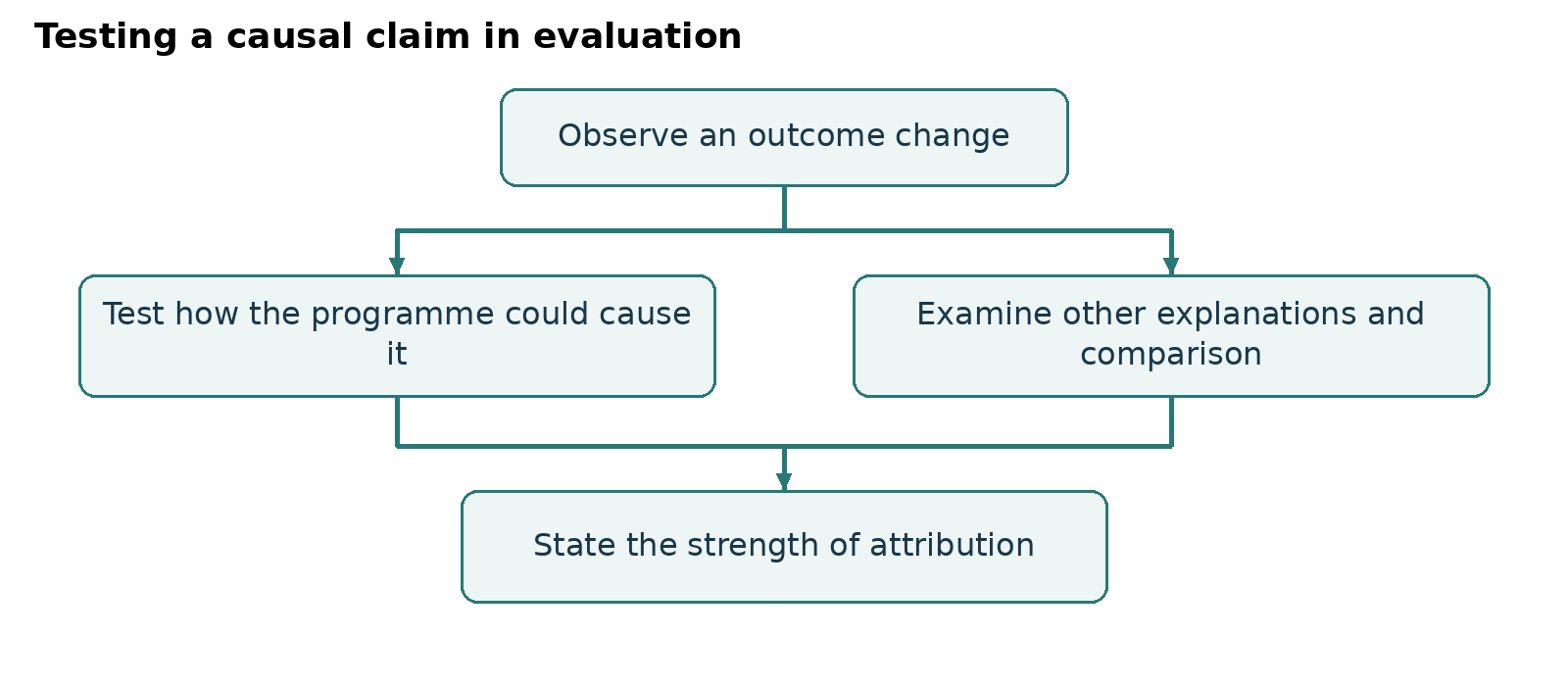
Figure 3 Testing a causal claim in evaluation
Bureaucrats influence policy through implementation as well as advice. Examine.
Answer direction. Establish political responsibility, then explain framing, bounded rationality and frontline discretion. Use the scholarship example to show how routines alter effective eligibility. Assess both the benefits of local judgement and the need for reasons, review and feedback.
Can monitoring data establish policy impact?
Answer direction. Distinguish inputs, outputs, outcomes and attribution. Show how a theory of change and a credible comparison improve an evaluation. Explain how field evidence can reveal unintended effects.
A Worked Evaluation Argument
Suppose attendance improves after a district expands school meal provision. Monitoring can establish how many schools served meals, how often deliveries were interrupted and which students were reached. These records help explain whether the intervention was implemented as designed. To examine impact, compare attendance trends before and after expansion and, where a defensible comparison exists, across schools with different timing or exposure. Ask whether a simultaneous transport improvement or enrolment drive could explain the difference.
Administrative judgement still matters. Averages can conceal interruptions in remote schools, so site visits and student accounts may reveal who received the intervention consistently. If the evidence supports a plausible contribution but cannot rule out competing explanations, report the conclusion at that level. The policy decision can then address delivery gaps while strengthening the evaluation design.
📣 Join our community